
Laser Cleaning
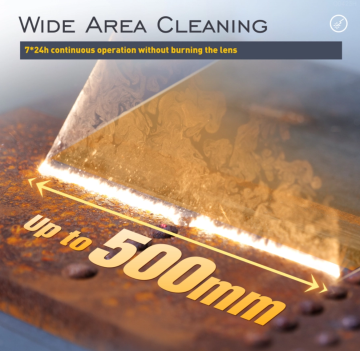
How to Remove Rust from Large Metal Surfaces Without Sandblasting
Rust, paint, oil, oxide, coatings, and other surface contaminants can be difficult to remove, especially when working with large metal components or heavily contaminated industrial surfaces. Traditional methods such as sandblasting, chemical cleaning, and mechanical grinding can be effective, but they may also create dust, chemical waste, consumables, noise, or unwanted surface damage.
Continuous laser cleaning offers a different approach.
By using a high-power continuous or modulated laser beam, continuous laser cleaning machines can efficiently remove rust, paint, oil, oxide layers, coatings, and other contaminants from a wide range of surfaces. Compared with pulsed laser cleaners, continuous laser systems are generally designed for higher-power, high-throughput industrial cleaning applications.
In this guide, we will explain what continuous laser cleaning is, how it works, where it is used, how it compares with pulsed laser cleaning, and how to choose the right laser power for your application.
Key Takeaways
Continuous laser cleaning uses a high-power continuous or modulated laser beam for surface treatment.
It is particularly suitable for heavy rust, thick paint, coatings, oil, and large-area cleaning.
Higher laser power generally provides greater cleaning efficiency for demanding industrial applications.
Laser cleaning is a non-contact process that requires no blasting media or chemical cleaning agents.
The SFX SLC Series offers 1500W, 2000W, 3000W, and 6000W solutions for different industrial cleaning requirements.
Smart connectivity, laser-source antifreeze technology, wide scanning widths, and continuous operation make the SLC Series suitable for demanding industrial environments.
What Is Continuous Laser Cleaning?
Continuous laser cleaning is a surface treatment technology that uses a continuous-wave (CW) or modulated fiber laser to remove unwanted materials from a surface.
Unlike mechanical cleaning, the laser does not need to physically touch the workpiece. Instead, concentrated laser energy is directed onto the contaminated surface.
When the laser energy is absorbed by rust, paint, oil, oxide, or other contaminants, the material rapidly heats and is removed through processes such as vaporization, thermal expansion, and ablation. By selecting appropriate laser parameters, operators can target the unwanted layer while minimizing the impact on the underlying substrate.
This makes continuous laser cleaning particularly attractive for metal surface preparation, industrial maintenance, restoration, and large-area cleaning.
How Does a Continuous Laser Cleaning Machine Work?
The basic cleaning process is relatively simple:
1. Laser Energy Is Generated
A fiber laser source generates a high-power laser beam, typically around the 1080 nm wavelength range for industrial metal cleaning applications.
2. The Laser Beam Is Delivered to the Cleaning Head
The laser beam travels through a fiber cable to the handheld laser cleaning head.
3. The Beam Scans Across the Surface
The cleaning head moves the laser beam rapidly across the target area. The scanning pattern distributes the laser energy over a controlled cleaning width.
4. Contaminants Absorb the Laser Energy
Different materials absorb laser energy differently. Rust, paint, oil, oxides, and coatings can absorb sufficient energy to be rapidly heated and removed.
5. The Clean Surface Is Revealed
After the unwanted layer is removed, the underlying surface is exposed without the need for abrasive blasting or chemical solvents.
The exact cleaning result depends on laser power, scanning width, scanning speed, focal position, material type, contaminant thickness, and other process parameters. Therefore, proper parameter selection and testing are important for achieving the desired result.
Continuous Laser Cleaning vs. Pulsed Laser Cleaning
One of the most common questions when purchasing a laser cleaning machine is:
Should I choose a continuous laser cleaner or a pulsed laser cleaner?
The answer depends mainly on the application.
| Feature | Continuous Laser Cleaning | Pulsed Laser Cleaning |
|---|---|---|
| Laser Mode | Continuous / Modulated | Pulsed |
| Typical Power | Higher power | Lower to medium power |
| Cleaning Efficiency | High | High precision |
| Heavy Rust | Excellent | Good |
| Thick Paint | Excellent | Good |
| Large Surfaces | Excellent | Suitable |
| Fine Cleaning | Suitable | Excellent |
| Heat Control | More thermal input | Lower thermal input |
| Typical Applications | Industrial cleaning, large metal surfaces, heavy contamination | Precision cleaning, delicate surfaces, molds, fine restoration |
Continuous laser cleaners are generally better suited to applications where speed, power, and productivity are the priorities.
Pulsed laser cleaners are often preferred when precision, low thermal input, and delicate surface treatment are more important.
For example, a large steel structure covered with heavy rust may benefit significantly from a high-power continuous laser cleaner, while a precision component requiring extremely controlled cleaning may be better suited to a pulsed laser system.
Why Choose Continuous Laser Cleaning for Industrial Applications?
1. High Cleaning Efficiency
One of the biggest advantages of continuous laser cleaning is its high power.
Higher-power laser systems can deliver more energy to the surface in a shorter period, making them particularly suitable for thick rust, paint, coatings, and large contaminated areas.
For industrial users, this can translate into higher productivity and shorter cleaning cycles.
2. Ideal for Large Metal Surfaces
Traditional manual cleaning becomes increasingly inefficient as the workpiece becomes larger.
Continuous laser cleaning machines can use wide scanning patterns to cover larger areas, reducing the number of passes required.
SFX's SLC Series, for example, includes models with cleaning widths of up to 400 mm, while the SLC-6050 reaches up to 500 mm.
3. Non-Contact Cleaning
The laser cleaning head does not need to physically contact the workpiece.
This eliminates abrasive contact between tools and the surface and allows operators to clean complex shapes, edges, and hard-to-reach areas more flexibly.
4. No Abrasive Media or Chemical Cleaning Agents
Unlike sandblasting or chemical cleaning, laser cleaning does not require blasting media or chemical solvents as the cleaning mechanism.
This can help reduce consumable requirements and secondary waste while creating a cleaner working process.
However, laser cleaning still requires appropriate fume extraction and safety procedures, especially when removing coatings, paint, or other hazardous contaminants.
5. Flexible Cleaning Width
A controllable scanning width allows operators to adapt the cleaning area to different workpieces.
A narrower width can be useful for more controlled cleaning, while a wider scanning area can improve productivity when cleaning large surfaces.
Common Applications of Continuous Laser Cleaning
Continuous laser cleaning is especially suitable for industrial applications where high cleaning efficiency is required.
Rust Removal
Rust removal is one of the most common applications.
Continuous laser cleaners can remove surface rust and corrosion from steel structures, machinery, automotive components, industrial equipment, and other metal parts.
Paint and Coating Removal
Laser cleaning can remove paint, powder coatings, and other surface coatings before repainting, welding, inspection, or refurbishment.
Oil and Grease Removal
Oil, grease, and other contaminants can be removed from metal surfaces before manufacturing, maintenance, or subsequent surface treatment.
Oxide Removal
Oxide layers can affect welding, coating adhesion, and surface quality. Laser cleaning provides a precise way to prepare metal surfaces before subsequent processing.
Mold Cleaning
Industrial molds can accumulate contamination during repeated production. Laser cleaning can help remove residues, oxides, and other unwanted materials without using abrasive cleaning methods.
Automotive Maintenance
Continuous laser cleaning can be used for automotive parts, chassis components, brake components, restoration work, and other metal surface preparation applications.
Heavy Equipment and Industrial Machinery
Large industrial equipment often requires regular rust, paint, oil, and coating removal.
The combination of high laser power and wide scanning makes continuous laser cleaning particularly suitable for these demanding environments.
How to Choose the Right Continuous Laser Cleaning Power?
Laser power is one of the most important factors when selecting a machine.
However, higher power does not automatically mean a better machine. The correct power depends on the contaminant, material, thickness, cleaning area, required speed, and production environment.
1500W: Flexible Industrial Cleaning
A 1500W continuous laser cleaner is a practical option for users who need industrial-level cleaning performance while maintaining relatively flexible equipment requirements.
It can be considered for rust, paint, oil, oxide, and coating removal on a variety of metal surfaces.
2000W: A Balanced Choice
A 2000W laser cleaner provides a strong balance between cleaning power, productivity, and application flexibility.
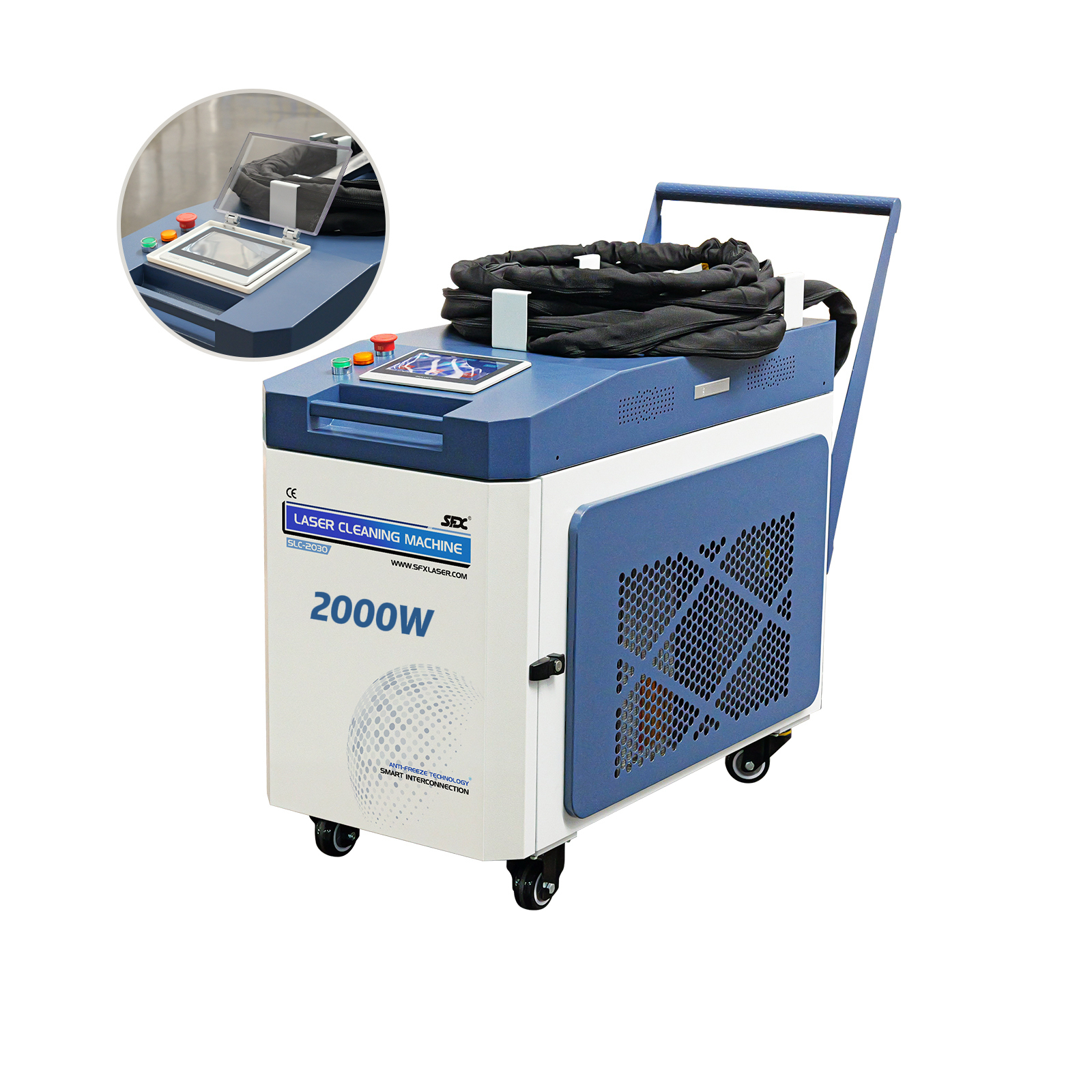
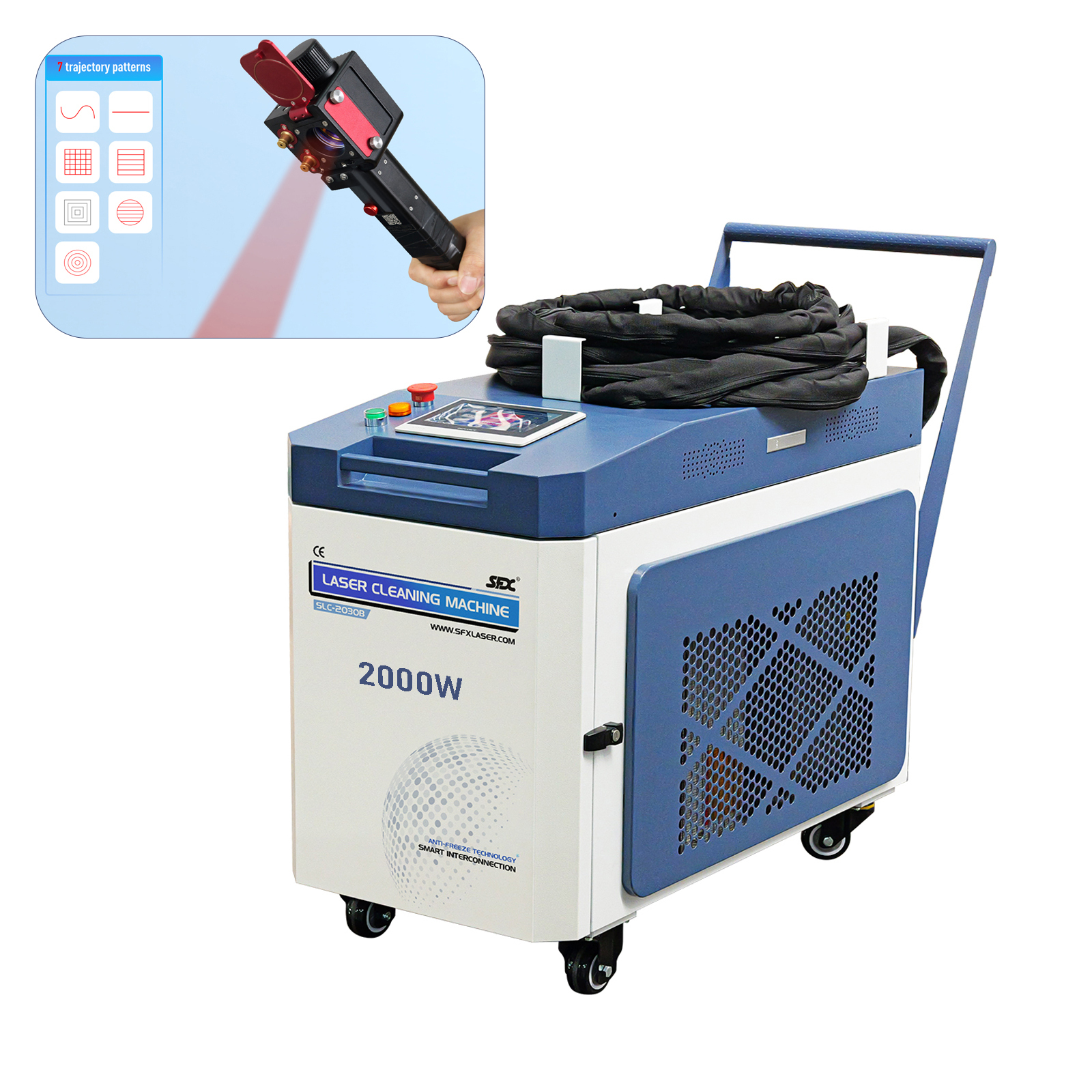
For example, the SFX SLC-2030 uses a 2000W fiber laser and supports an adjustable scanning width of approximately 10–300 mm.
It is suitable for applications such as rust removal, paint stripping, oxide removal, mold maintenance, automotive repair, and industrial surface preparation.
3000W: High-Productivity Cleaning
When the cleaning area becomes larger or the contamination becomes heavier, a 3000W system can provide additional cleaning capacity.
The SFX SLC-3040 offers 3000W laser power and a maximum cleaning width of up to 400 mm, making it suitable for demanding industrial cleaning applications.
6000W: Heavy-Duty Industrial Cleaning
For very large surfaces and high-throughput industrial applications, a 6000W system can provide substantially greater cleaning capacity.
The SFX SLC-6050 delivers 6000W laser power with a maximum scanning width of up to 500 mm and is designed for large-scale rust, paint, oil, and oxide removal.
Meet the SFX SLC Series Continuous Laser Cleaning Machines
For users looking for a high-power industrial laser cleaning solution, the SFX SLC Series is designed around efficiency, flexibility, and long-term industrial operation.
The current SLC lineup includes:
SLC-1525 – 1500W
SLC-2030 – 2000W
SLC-3040 – 3000W
SLC-6050 – 6000W
The series is designed for applications including rust removal, paint stripping, coating removal, oil cleaning, oxide removal, industrial maintenance, and large-area metal surface preparation.
Wide Scanning Width
The SLC Series is designed with wider cleaning coverage to improve productivity.
The SLC-3040 can reach a cleaning width of up to 400 mm, while the SLC-6050 can reach up to 500 mm.
This makes the series particularly useful for large metal components and industrial structures.
Smart Interconnection
Selected SLC models feature smart interconnection technology that allows users to remotely adjust parameters and perform machine operations through a smartphone.
This can be especially useful for industrial users who need remote monitoring, parameter adjustment, or technical assistance.
The SFX SLC-2030 also supports online diagnosis, allowing technical teams to assist with troubleshooting remotely.
Laser Source Antifreeze Technology
Cold environments can create challenges for water-cooled laser equipment.
The SLC Series incorporates laser-source antifreeze technology designed to reduce risks associated with low-temperature operation and storage. SFX states that this technology can support operation in temperatures as low as -10°C for applicable models.
Designed for Continuous Industrial Operation
The SLC Series is designed for demanding working environments where consistent performance and productivity are important.
Its industrial configuration and water-cooling system are intended to support high-power continuous cleaning applications.
360° Handheld Cleaning
The handheld cleaning head provides flexibility when working around irregular shapes, corners, edges, and difficult-to-reach areas.
This allows operators to move around the workpiece rather than being restricted to a fixed cleaning position.
Which SFX SLC Model Should You Choose?
| Model | Laser Power | Max. Cleaning Width | Best For |
|---|---|---|---|
| SLC-1525 | 1500W | Up to 250 mm | General industrial cleaning |
| SLC-2030 | 2000W | Up to 300 mm | Rust, paint, oil, coating removal |
| SLC-3040 | 3000W | Up to 400 mm | Heavy-duty and large-area cleaning |
| SLC-6050 | 6000W | Up to 500 mm | High-throughput industrial cleaning |
The best model depends on the contamination level, workpiece size, required cleaning speed, material, and available power supply.
If you are unsure which laser power is suitable, testing the actual material and contamination before purchase is recommended.
Continuous Laser Cleaning vs. Traditional Cleaning Methods
Compared with grinding, sandblasting, and chemical cleaning, continuous laser cleaning offers several potential advantages.
Grinding
Grinding relies on physical contact and abrasive tools. It can be effective for localized cleaning but may create dust and alter the surface profile.
Sandblasting
Sandblasting provides strong cleaning performance for large surfaces but requires abrasive media and produces significant dust and waste.
Chemical Cleaning
Chemical cleaning can remove certain coatings and contaminants effectively, but it involves chemical handling, storage, ventilation, and disposal considerations.
Continuous Laser Cleaning
Laser cleaning is a non-contact process that can remove rust, paint, oil, oxides, and coatings without blasting media or chemical cleaning agents.
The right method ultimately depends on the material, contamination, production requirements, surface condition, and operating environment.
Important Factors to Consider Before Buying a Laser Cleaning Machine
Before investing in a continuous laser cleaner, consider the following:
Material: What material are you cleaning?
Contaminant: Are you removing rust, paint, oil, oxide, coating, or another substance?
Contaminant Thickness: Thick contamination may require higher laser power.
Workpiece Size: Large surfaces benefit from wider scanning widths.
Required Cleaning Speed: Higher power can support higher productivity for suitable applications.
Working Environment: Consider temperature, humidity, ventilation, and available electrical power.
Cooling System: High-power continuous systems generally require effective cooling.
Fiber Cable Length: Choose a cable length suitable for your work area.
After-Sales Support: Technical support and spare parts availability are important for industrial equipment.
Safety: Proper laser safety controls, protective equipment, and a suitable operating environment are essential.
Final Thoughts
Continuous laser cleaning is becoming an increasingly attractive solution for industrial surface preparation and maintenance.
Its combination of high laser power, non-contact cleaning, wide scanning capability, and flexible handheld operation makes it particularly suitable for heavy rust, paint, coating, oil, and oxide removal on large metal surfaces.
For users who need a scalable industrial solution, the SFX SLC Series provides multiple power options from 1500W to 6000W. From the versatile SLC-1525 and SLC-2030 to the high-productivity SLC-3040 and heavy-duty SLC-6050, the series can cover a wide range of industrial cleaning requirements.
Looking for the right continuous laser cleaning machine for your application? Explore the SFX SLC Series and contact SFX Laser for professional application advice and machine recommendations.
0users like this.
Hot sale




Copyright © SFX Laser. All Rights Reserved.

Your cart is currently empty.